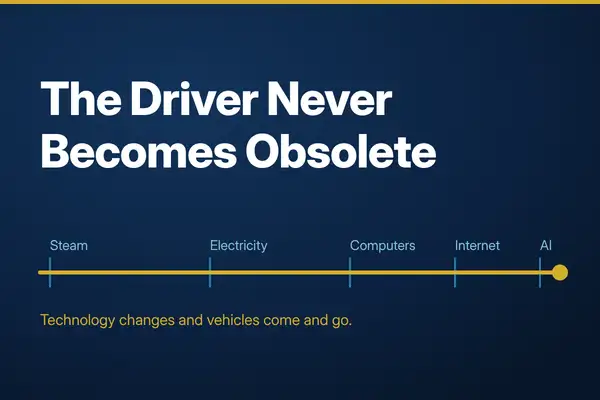
The Driver Never Becomes Obsolete
The Driver Never Becomes Obsolete
In 1885 Karl Benz developed what is generally recognised as the first practical car powered by an internal-combustion petrol engine. For the next 140 years humans have improved it to the incredible machines we see today. All based upon the same technology developed in the 1800’s. And no matter how many incremental improvements we plaster on top of an outdated technology, it is still outdated and becoming increasingly not fit for purpose.
I see the same with how we prepare our children for their futures.
And I don't mean the obvious stuff. I'm not here to tell you the phones are bad, or that the feed is stealing your child's attention, or that school has fallen behind. You already sense all of that. You feel it in your gut at the school gate, and you file it away as something you'll deal with later.
This is the thing underneath all of it. The one nobody is saying out loud.
The single greatest asset a human being has, the thing that decides whether we can hold our life together when everything around it changes, is the one thing we are not teaching our children at all.
Mental agency.
Stay with me. Because once you see what’s happening, you won't be able to unsee it. And that's the point.
How fast this is really moving
A mere few generations ago a family largely stayed in one town and did one job for generations. Our surnames still say it. Smith. Cooper. The blacksmith's son became the blacksmith. That was how society worked.
Then, as technology enabled more, society changed with it. The labourer's son became the clerk. The clerk's son attended university. The graduate’s son became the accountant. And with each generation, the ground shifted a little faster and spread a little wider under a family's feet.
Now we're not asking what a child will become. We're asking whether the thing they train for today will still exist by the time they finish training.A career used to last a lifetime. Then a decade. Now it’s a few years. Soon, it will be months. That's not a prediction; it’s the inevitable result of relentless technological advances.
The steam engine. Electricity. The computer. The internet. Now artificial intelligence, layered on top of all of them at once. Each new wave didn't just change how work got done. It changed who got left behind.
A hundred years ago, a hundred men could plow a field for a month. Then two men and a tractor did it in two days. Ninety-eight men displaced. The value of their skill evaporated overnight, and nobody handed them a new one.
In hindsight we see it clearly. But when it’s happening to you and all around you, it’s very difficult. As the saying goes; you can’t read the label when you’re inside the bottle. And it happening again, right now, and those that will be impacted the most, and the least equipped to defend themselves, are your children.
The problem isn't the technology
Here's the part people often get wrong, and I say this as someone with three decades of reading the numbers and making hard calls under pressure.The problem was never the tractor. Technology more often than not provides net positive gains to society. The problem was that the people were still being trained for a way of work that was disappearing.
And it’s happening again, and at a scale that makes the three previous industrial revolutions pale into insignificance. We still train children to follow instructions, remember things, not rock the boat, and wait their turn. Then we hand them into a world that rewards the ability to stand up, stand out and make a difference when the instructions stop making sense, and the rules seemingly vanish.
That's agency. And it's trainable. It's just that almost nobody is training it.
Technology isn't the villain here. Technology is the reason the stakes have never been higher. The same force that can automate your child's future job is the force that makes a person with agency priceless. When anyone can produce an answer, the people who win are the ones who know which questions to ask. When content is free, the value moves to context. When machines do the work, what's left is the human being doing the deciding.
Your child doesn't need to out-work a machine. That's a race they can't win. They need to learn the one skill that makes them the driver, not a component in the car.
Why this matters to me
I have built robust, results-driven systems in high-stakes environments for three decades. Across multiple industries from property to banking and financial services, and from consumer goods to telecoms and security. Then I built my own companies and successfully exited twice.Equipped with enough qualifications in business and finance, I've spent my life making decisions where being wrong cost real money.
I have come to this work through lived experience. So this is personal, not theory. Over three recent years I was handed a series of life shocks that fully tested me across my health, livelihood, finances identity, and relationships. I saw no option but to rebuild from the ground up, from first principles. And what I found in that rebuild changed everything.
I found the knowledge and tools that build mental and personal agency are not complicated, and not secrets. They exist and are trainable. They are just not available until far too late. By the time most people access them the job has become repairing, not building capability.
So, I moved the mission upstream.
I'm building a system for developing mental agency and improved performance aimed at enabling our children. But I'm starting with the adults who shape a child's world: the parents, and thereafter teachers and coaches. Because a major predictor of anyone’s success is your environment and you cannot model a skill you don't yet possess yourself.
What this means for you
You don't need to become a neuroscientist, and you don't need to overhaul your family's life this weekend.
You just need to notice that the feeling you get at the school gate, the one you keep filing away for later, is trying to tell you something real. Notice that the world your child will inherit is not the world you were trained for, and that pretending otherwise is the one genuinely expensive choice available to you.
The good news is that it’s solvable. Agency is not a talent some children are born with. It's a skill they can learn, and it compounds. So it’s best built early. The parents who start now, gently and deliberately, are giving their children the thing that will outlive every skill school can teach them, every app, every algorithm, every change between careers that haven’t been invented yet.
Technology changes and vehicles come and go. It’s the driver that never becomes obsolete. It’s time to teach them to handle whatever is put in front of them.
This is the start of me writing about Mental Agency and Human Potential. I have chosen to write this out in public because it's the first chapter of a book. I believe the best way to fail slowly is to write it alone in a room and find out later what I got it wrong.
So tell me: where did this land for you? Where did I lose you, or worse, where did I get it wrong? Drop it in the comments or better, send me a message. I'd rather hear it now than in a footnote.
And if this landed, say so. It's how I'll know what to write next.